 Reformix AI
Recyclable Polymer Design
Reactive molecular dynamics of an oxalic acid and DGEBA vitrimer
Preprint·ChemRxiv, CC BY 4.0
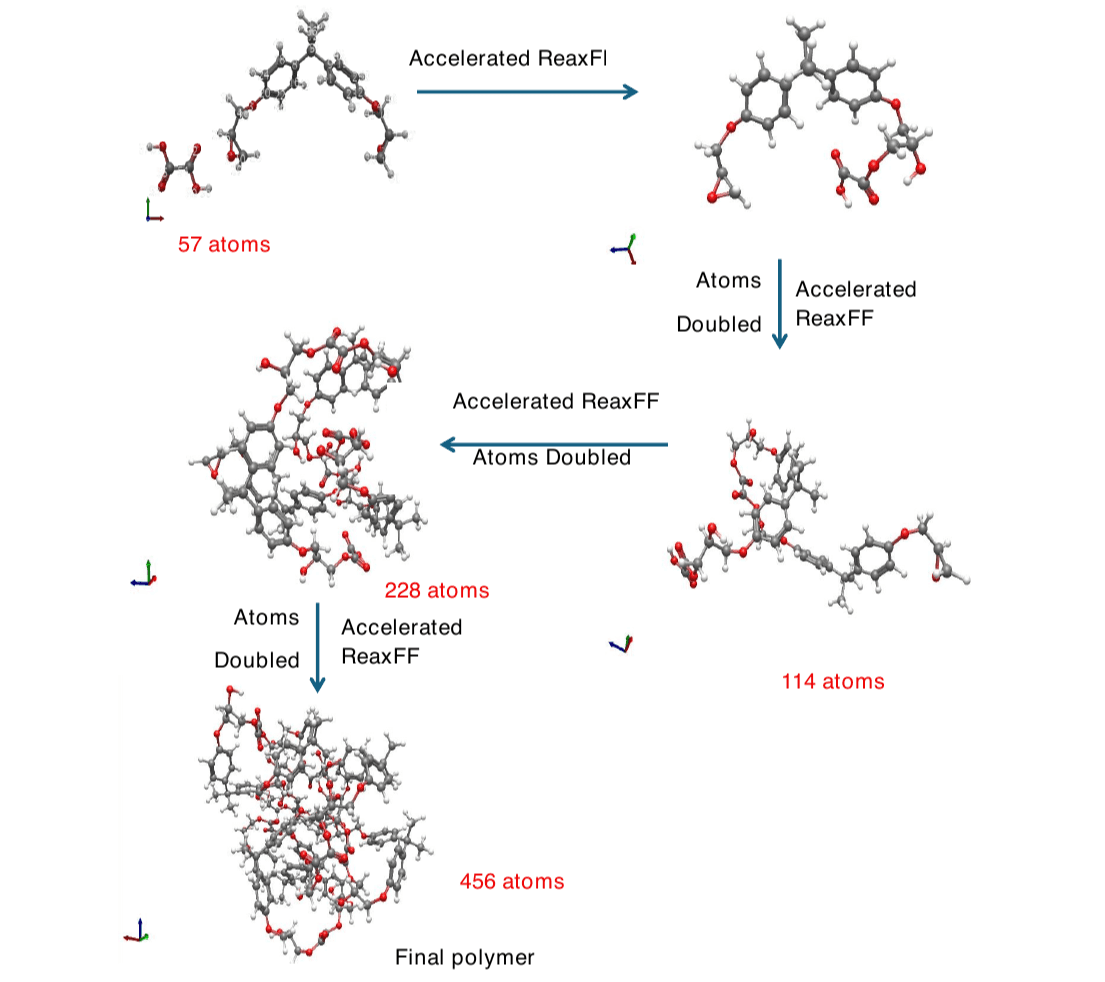
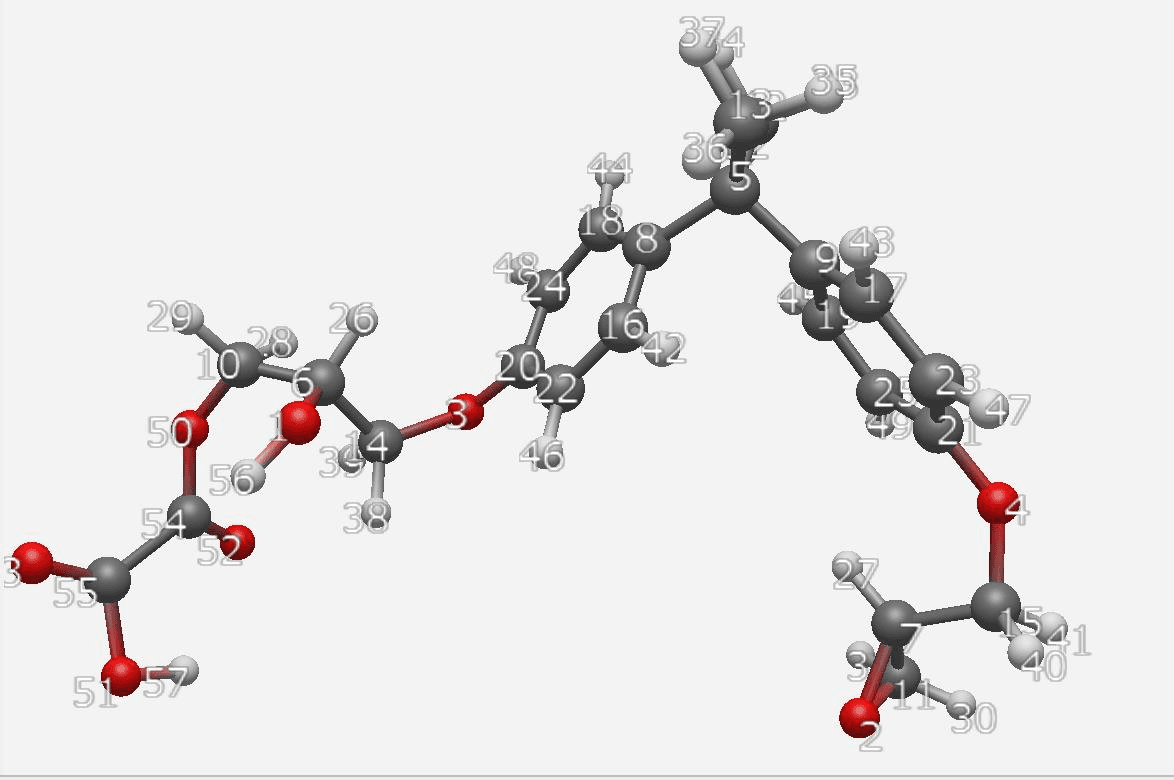
Figure 9: Polymerization scheme of DGEBA and oxalic acid, built from 57 to 114, 228 and 456 atoms. 1:1 stoichiometry is maintained at every step.
- Atoms in final chain
- 456
- Density at 300 K
- 1.2975g/cm3
- Glass transition (Tg)
- about 76C
- Young's modulus
- 4.36GPa
- Poisson's ratio
- 0.371
Data description
Vitrimers are crosslinked polymers whose bonds can rearrange, so a strong network can still be reshaped and recycled. Designing them is hard because crosslinking is too slow to follow with ordinary molecular dynamics.
We simulate the polymerization of DGEBA and oxalic acid at 1:1 stoichiometry with reactive molecular dynamics in LAMMPS, using the ReaxFF CHNO-2017_weak force field. A COLVARS harmonic bias on three distances drives an SN2-like nucleophilic attack, then proton transfer, giving a beta-hydroxy ester. The network is built hierarchically at 57, 114, 228, 456 atoms.
The annealed polymer has a density of 1.2975 g/cm3 at 300 K and a glass transition near 76 C, both above the adipic acid vitrimer of Kamble et al. Uniaxial tension at 2e9 1/s gives a mean Young's modulus of 4.36 GPa and a Poisson's ratio of 0.371.
| Detail | Value |
|---|---|
| Reaction | DGEBA + oxalic acid, 1:1 |
| Force field | ReaxFF CHNO-2017_weak, fix qeq/reax |
| Bias method | COLVARS, harmonic bias on 3 distances |
| Temperature | 423 K |
| Timestep | 0.05 fs |
| Ensemble | NVT, Nose-Hoover |
| Software | LAMMPS, ORCA |
| Final system | 456 atoms (8 DGEBA + 8 oxalic acid) |
Intended use
Recyclable thermosets
Screen vitrimer chemistries that keep thermoset strength but can be reprocessed at end of life.
Self-healing materials
Study how rearranging bonds in the network could let a damaged part repair itself.
Property prediction before synthesis
Estimate density, glass transition and stiffness from simulation before anyone mixes a resin.
Comparable studies
The oxalic acid network is compared with the adipic acid and DGEBA vitrimer reported by Kamble et al. Reformix is shown in blue.
Density at 300 K
g/cm3- Oxalic acid vitrimer (this work)Reformix1.2975g/cm3
- Adipic acid vitrimerKamble et al.1.215g/cm3
Glass transition temperature (Tg)
C- Oxalic acid vitrimer (this work)Reformix76C
- Adipic acid vitrimerKamble et al.42.8C
Directional properties
Values from uniaxial tension along each axis at 2e9 1/s strain rate.
Young's modulus by direction
GPa- X axis4.29
- Y axis2.67
- Z axis6.13
Mean 4.36 +/- 1.00 GPa
Poisson's ratio by direction
- X axis0.37545
- Y axis0.3878
- Z axis0.3487
Mean 0.371 +/- 0.012
Simulation
Structural relaxation and density behavior during polymerization and annealing.
RMSD plateau, stage 1
A0.9
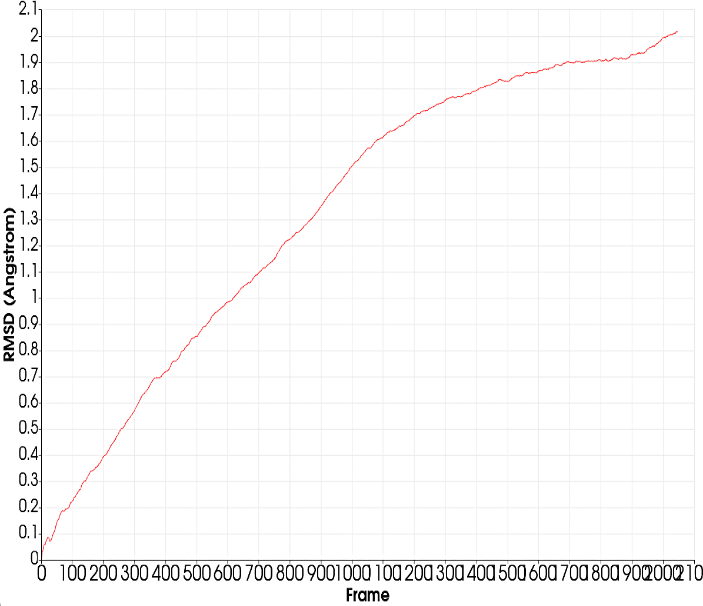
RMSD plateau, stage 2
A2.6
RMSD during polymerization
Fig 8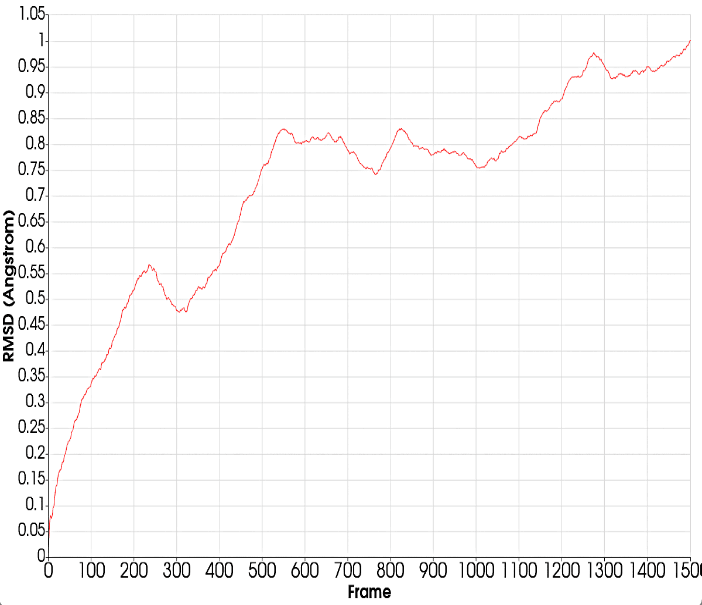
Density during annealing
Fig 10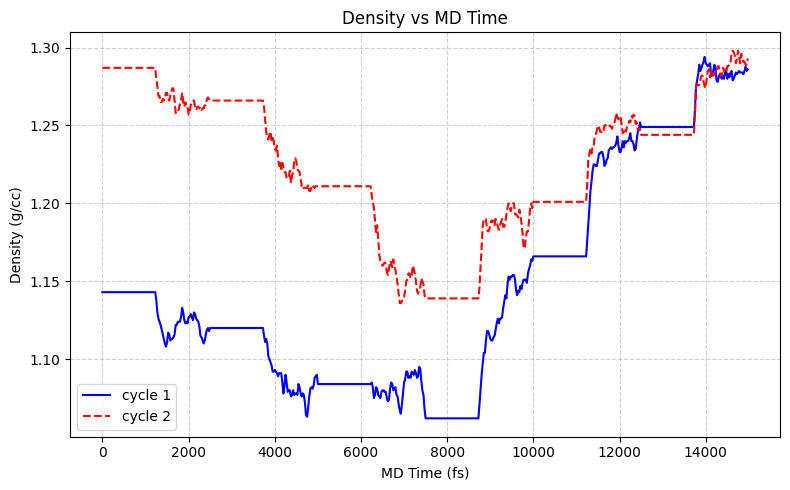
Density time series at 300 K
Fig 12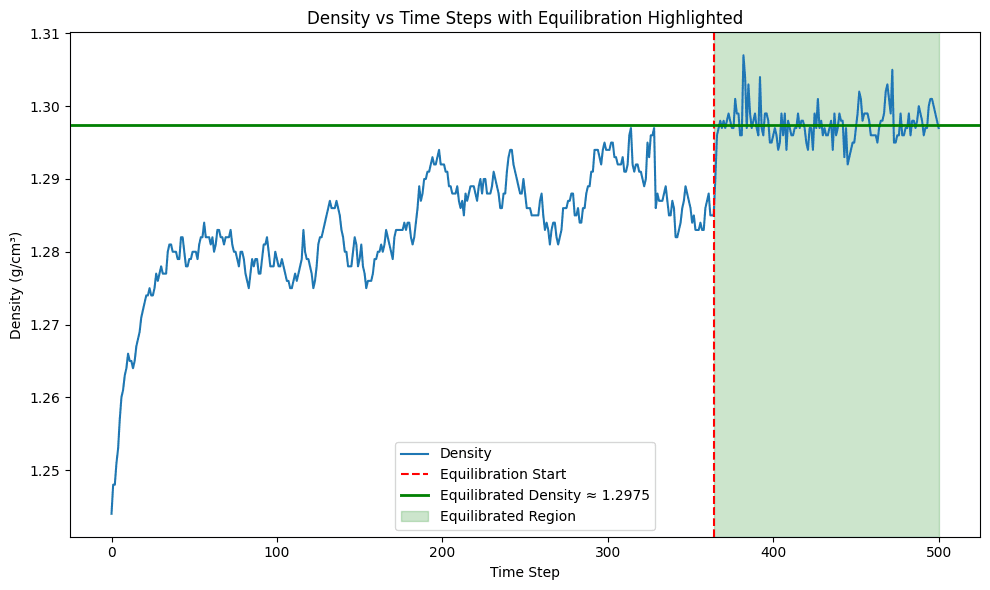
Thermomechanical analysis
Density vs temperature
Fig 13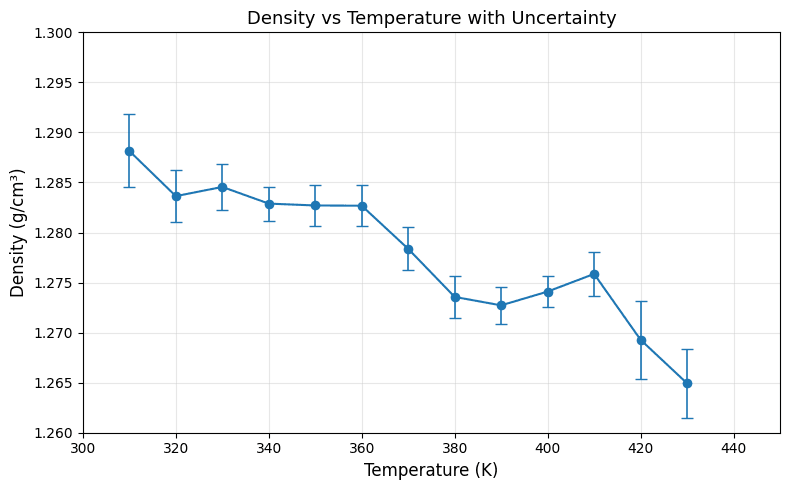
Tg inflection
Fig 14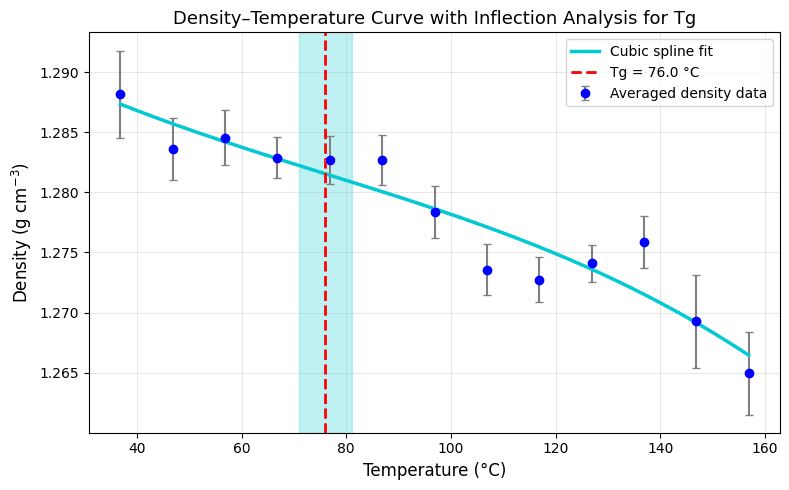
Stress-strain, X direction
Fig 16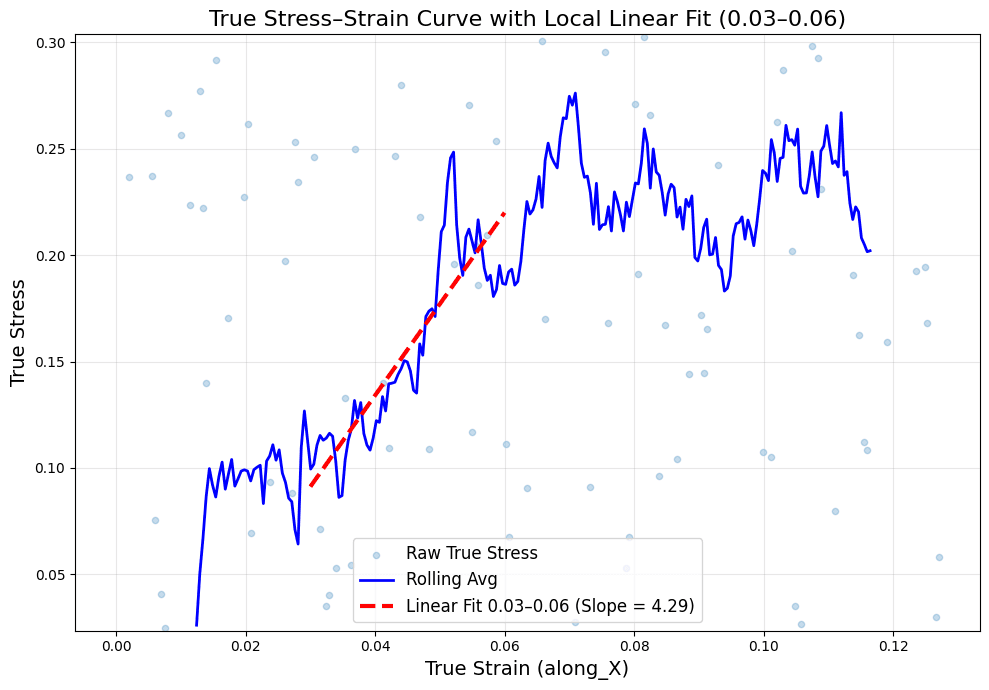
Poisson's ratio fit
Fig 17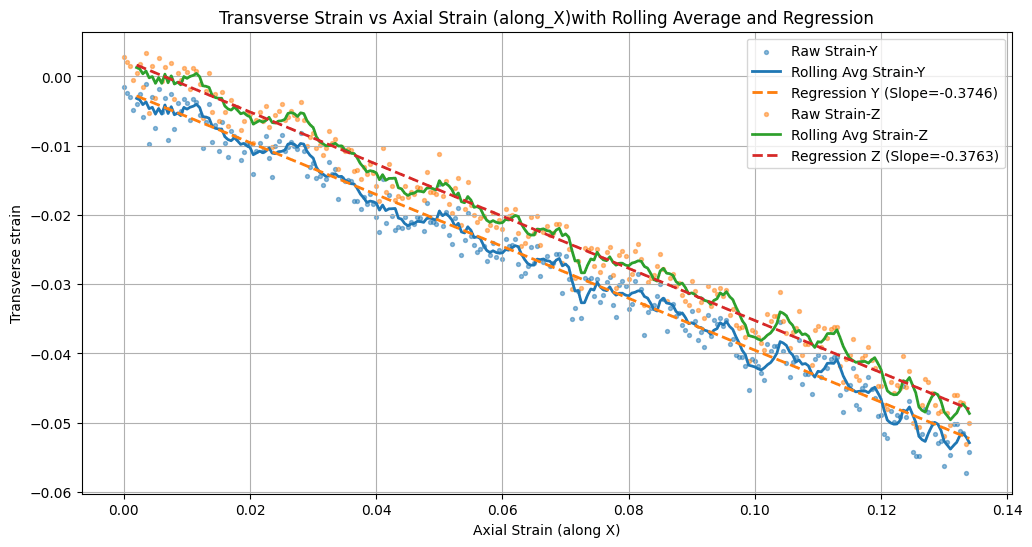
Validation
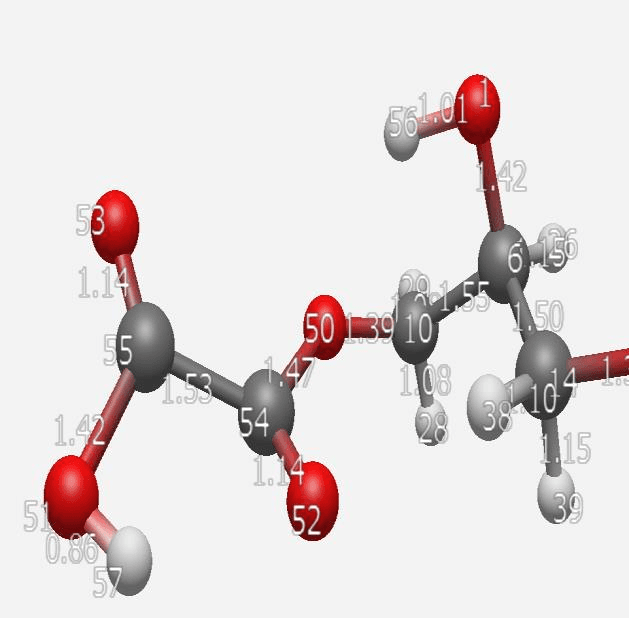
Key bond lengths along the reaction path from the biased trajectory.
| Bond | Length (A) |
|---|---|
| TS epoxide C-O | 2.10 |
| Forming C-O | 1.77 |
| Product ester C-O | 1.31 |
| Beta-hydroxy C-O | 1.42 |
| O-H | 1.01 |
Transition state and product geometries
Fig 7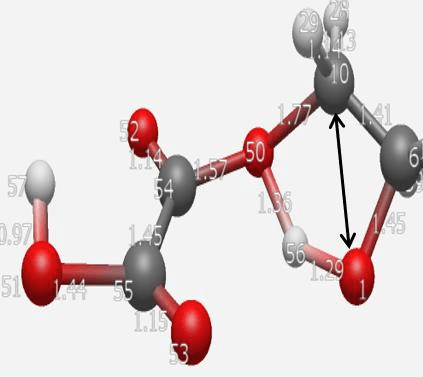
Method
Distance-based crosslinking compared with COLVARS-biased reactive MD.
Reaction mechanism
Fig 2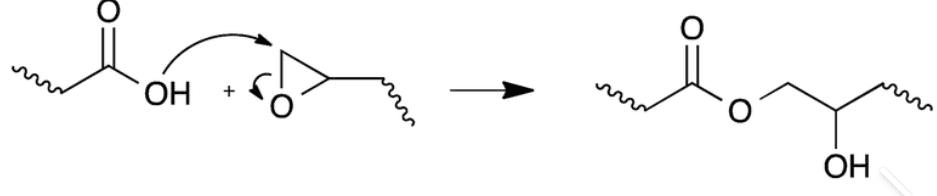
| Distance-based crosslinking | COLVARS-biased MD | |
|---|---|---|
| Mechanism | A bond is added once two atoms come within a cutoff | A harmonic bias drives attack, then proton transfer |
| Steric effects | Largely ignored | Captured by the reactive force field along the path |
| Temperature | Reaction step is separate from the dynamics | Runs in the dynamics at 423 K, NVT |
| Atomistic detail | Topology changes without a reaction path | Bond breaking and forming with charge equilibration |
Metadata
Table 1. COLVARS parameters, stage 1k in kcal/mol/A^2, distances in Acv pair init_A target_A k lo_wall lo_k hi_wall hi_kdist_CO_epoxide O(epoxide)-C(epoxide) 1.399 2.4 80 1 5 4.5 5dist_CO_acid C(epoxide)-O(acid) 5.459 1.43 800 1 5 6.5 5d_H_diff H(acid)-O(epoxide) 5.761 1.1 500 -8 2 8 2Harmonic bias on each collective variable xi: V_bias(xi) = 1/2 * k * (xi - xi_target)^2Harmonic walls keep xi inside its bounds: V_lower(xi) = 1/2 * k_lower * (xi - lower_wall)^2 for xi < lower_wall V_upper(xi) = 1/2 * k_upper * (xi - upper_wall)^2 for xi > upper_wallCitation
Published work using these results should cite the preprint as below.
Reference
Reformix AI. COLVARS-Driven Reactive Molecular Dynamics of Vitrimer Polymerization and Thermomechanical Property Analysis. ChemRxiv, 2026. https://doi.org/10.26434/chemrxiv-2026-k6fn6
@misc{reformix2026colvars, title = {COLVARS-Driven Reactive Molecular Dynamics of Vitrimer Polymerization and Thermomechanical Property Analysis}, author = {Reformix AI}, year = {2026}, publisher = {ChemRxiv}, doi = {10.26434/chemrxiv-2026-k6fn6}, note = {Preprint},}Get the paper
Preprint. Posted 2026-01-03 on ChemRxiv under CC BY 4.0.